🚀 SDLC Transformation with AI: From Writing Code to Engineering Intent
Discover how AI is reshaping the Software Development Life Cycle (SDLC), transforming developers from coders into architects, reviewers, and orchestrators of intelligent systems.
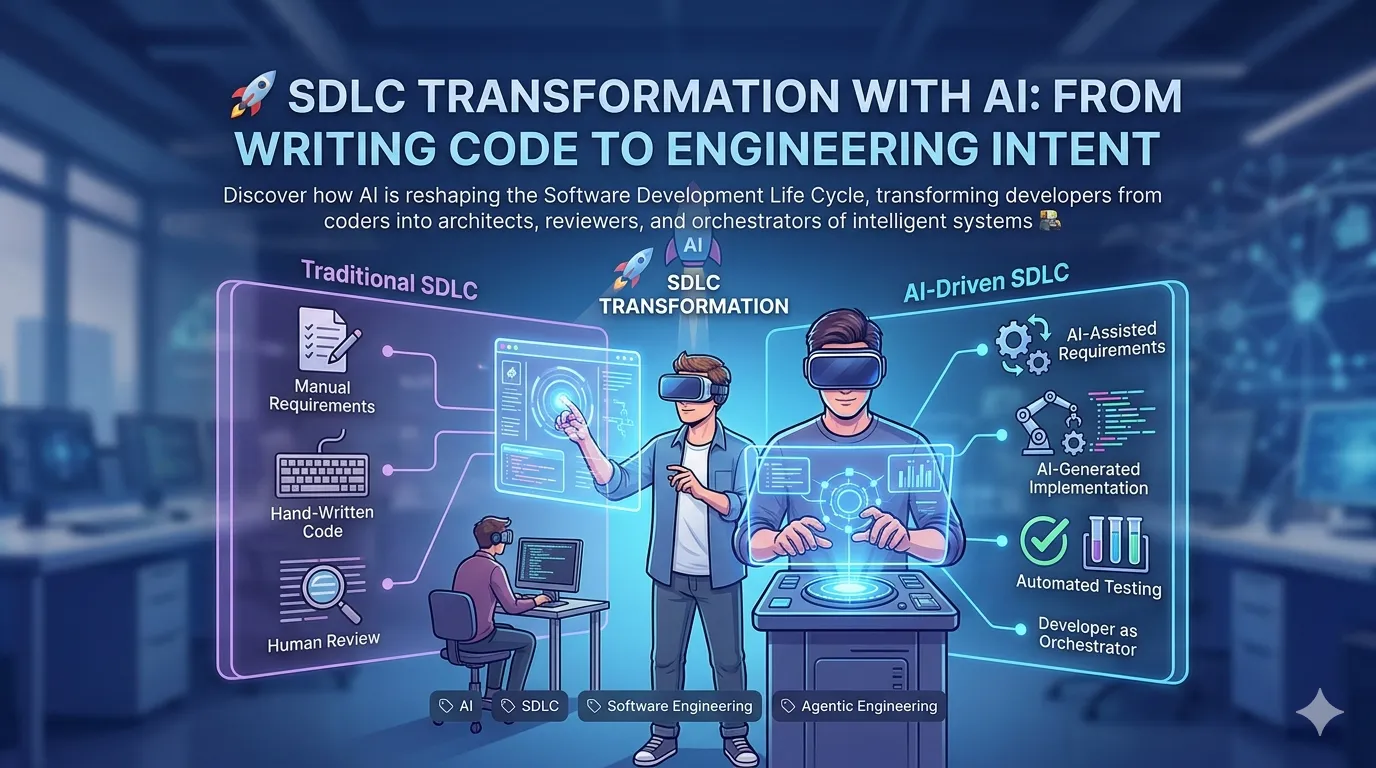
🚀 SDLC Transformation with AI: From Writing Code to Engineering Intent
For decades, software development revolved around writing code manually. Developers translated business requirements into syntax, implemented features, tested applications, and maintained systems throughout their lifecycle.
Today, Artificial Intelligence is fundamentally changing that process.
Modern AI coding agents can generate features, create tests, review code, and even deploy applications. The focus is shifting away from writing every line of code toward defining intent, architecture, and quality standards.
In this article, we’ll explore how AI is transforming the Software Development Life Cycle (SDLC), the rise of agentic engineering, and what developers need to succeed in this new era.
Let’s dive in 👇
🧠 Introduction Section
AI is compressing traditional software development timelines while changing the responsibilities of engineers.
- Developers increasingly describe what should be built rather than manually implementing every detail.
- AI agents can generate code, run tests, and perform multi-file modifications autonomously.
- Human expertise remains critical for architecture, validation, security, and business alignment.
👉 The future of software development is not human vs AI—it’s human judgment amplified by AI execution.
📖 Main Topic Section
🔹 AI-Powered Requirements & Planning
Traditionally, converting business requirements into technical specifications was slow and error-prone.
With AI:
- User stories can be generated directly from product requirements.
- AI can identify edge cases and missing requirements.
- Interactive prototypes can be created within minutes.
👉 Requirements become an ongoing collaboration between humans and AI instead of static documents.
🔹 AI-Assisted Development & Testing
Implementation is experiencing the biggest acceleration.
- AI agents can generate complete features from natural language descriptions.
- Automated test generation improves coverage and catches edge cases.
- Developers spend more time reviewing and validating than typing code.
👉 The role of developers is shifting from implementation to verification and guidance.
🔹 Agentic Engineering & Context Engineering
Not all AI-assisted development is the same.
At one end lies vibe coding—quick prompting with minimal oversight.
At the other lies agentic engineering—a structured approach involving:
- Architecture documents
- Context-rich instructions
- Automated testing
- Guardrails and quality controls
👉 The quality of AI output depends less on prompting and more on the quality of context provided.
📊 Comparison Table
| Feature | Traditional SDLC | AI-Driven SDLC |
|---|---|---|
| Requirements | Manual documentation | AI-assisted refinement |
| Development | Hand-written code | AI-generated implementation |
| Testing | Mostly human-created | AI-generated and automated |
| Code Review | Human-only review | AI + Human review |
| Deployment | Manual monitoring | AI-assisted observability |
| Developer Role | Code creator | Architect & orchestrator |
👉 AI accelerates implementation while increasing the importance of human oversight and decision-making.
🎯 Best Practices
- ✅ Create clear architecture and design documents before using AI
- ✅ Build automated tests and evaluation suites early
- ✅ Use AI for repetitive implementation tasks
- ✅ Maintain strong code review practices
- ❌ Never deploy AI-generated code without verification
👉 Treat AI as a highly productive junior engineer, not an infallible expert.
⚠️ Common Mistakes
Mistake #1
Blindly accepting AI-generated code.
AI-generated code can appear correct while containing hidden logic errors, security issues, or scalability problems.
Mistake #2
Skipping architecture and planning.
Many teams focus on prompts instead of defining clear requirements and system boundaries.
Mistake #3
Using vibe coding in production systems.
Rapid prototyping techniques work for experiments but can introduce technical debt in production environments.
👉 Strong testing, architecture reviews, and human validation are essential for long-term success.
🧠 Final Thoughts
AI is transforming every phase of the Software Development Life Cycle.
✔ Requirements can be refined and prototyped faster.
✔ Development and testing are increasingly automated.
✔ Developers are evolving into architects, reviewers, and orchestrators of intelligent systems.
The organizations that succeed will combine AI-powered productivity with strong engineering discipline.
👉 The future belongs to teams that master both AI capabilities and human judgment.
💡 Pro Tip:
Before asking an AI coding assistant to implement a feature, write a clear specification and define success criteria. Better inputs lead to dramatically better outputs.